

Retina & Glaucoma Center
Trusted expertise to safely protect your eye health.
What is Glaucoma?



An optic nerve disease driven by intraocular pressure
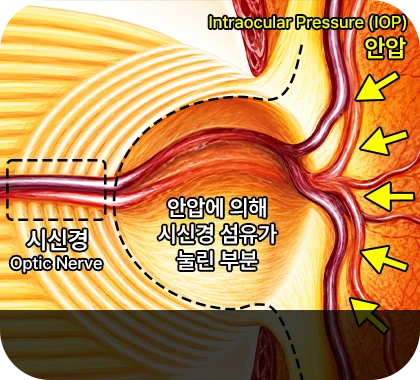
Glaucoma is a disease in which the optic nerve is damaged due to elevated intraocular pressure (IOP) compressing the nerve, or impaired blood supply to the optic nerve. Because the optic nerve transmits light information from the eye to the brain, its damage causes visual field defects and, in advanced stages, blindness. Optic nerve damage is irreversible, and early-stage glaucoma is often asymptomatic. Regular eye examinations are therefore essential for early detection — even in the absence of symptoms.
Why?
Why choose JC Bitsomang Eye Clinic for glaucoma diagnosis and treatment?
Early diagnosis is critical for glaucoma management.
··· 01 ···
Collaborative care led by 10 board-certified ophthalmologists with extensive expertise
··· 02 ···
Advanced diagnostic and surgical equipment for accurate diagnosis and treatment
··· 03 ···
Systematic, personalized treatment tailored to each patient's glaucoma progression
··· 04 ···
Comprehensive ocular screening program for early glaucoma detection
Causes of Glaucoma
The main cause of glaucoma is optic nerve damage from elevated intraocular pressure. Two mechanisms have been proposed for this damage: mechanical compression by the elevated IOP, and impaired blood flow to the optic nerve. The exact cause remains unknown and is still under active research. IOP is determined primarily by aqueous humor — the fluid produced inside the eye that maintains its shape and supplies nutrients. Aqueous humor is produced by the ciliary body behind the iris and circulates out of the eye in equal volume. When too much is produced or its outflow is obstructed, IOP rises and glaucoma develops. Risk is higher in those with a family history of glaucoma, naturally elevated IOP, or coexisting hypertension, diabetes, cardiovascular disease, or myopia.
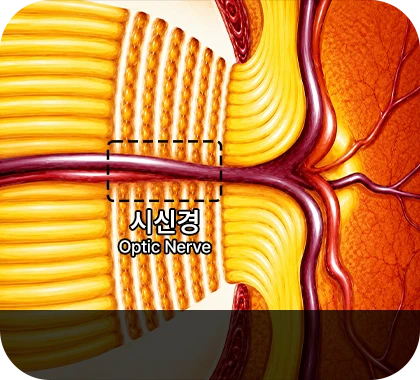
Glaucoma Symptoms
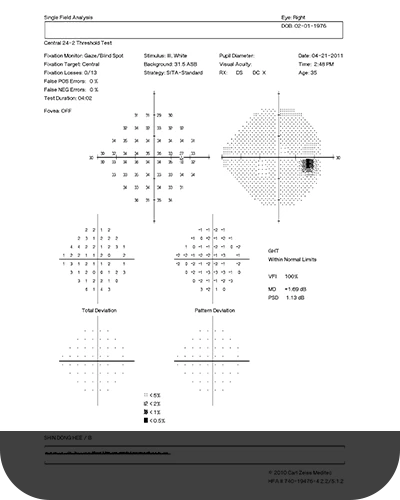
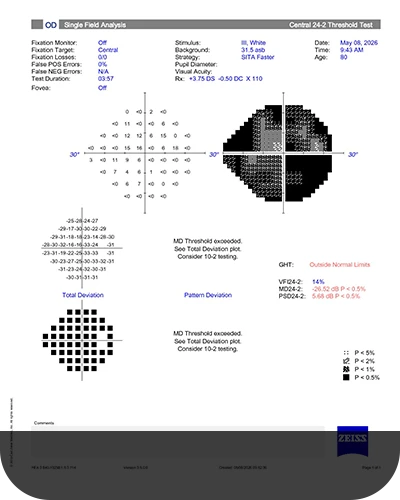
Roughly 90% of glaucoma patients experience no noticeable symptoms. The visual field narrows so gradually that patients only sense restriction in the late stages, and progression eventually leads to vision loss and blindness. The remaining 10% — acute glaucoma — presents abruptly with eye pain, redness, headache, vomiting, and decreased vision. Halos around lights may also appear. With treatment the pain and vomiting subside, but visual field defects can persist; the longer recovery is delayed, the more severe the residual deficit.
Types of Glaucoma
Glaucoma can progress slowly through gradual optic nerve damage, making continuous monitoring and treatment essential.
Normal-tension glaucoma
Optic nerve damage progresses despite IOP remaining within the normal range (10–21 mmHg).
Open-angle glaucoma
Aqueous humor exits through a normally shaped angle, but excessive production raises IOP above normal and progressively damages the optic nerve.
Narrow-angle glaucoma
The drainage angle is anatomically narrow, preventing adequate outflow of aqueous humor. IOP rises significantly, causing eye pain, headache, decreased vision, and — in the worst case — blindness.
Acute angle-closure glaucoma
Usually caused by relative pupillary block — contact between the pupil and the anterior lens prevents aqueous humor from passing forward, accumulating posteriorly and pushing the peripheral iris forward to close the anterior chamber angle. Onset is typically acute with sharp IOP elevation, severe eye pain, headache, nausea, and sudden vision loss.
Secondary glaucoma
Glaucoma developing secondarily from trauma, inflammation, tumors, hemorrhage, advanced cataract, diabetes, or steroid medication. Treatment depends on the underlying cause; left untreated, blindness can result regardless of cause.