



Often Dismissed as an Age-Related Condition, Untreated Epiphora May Lead to Nasolacrimal Duct Obstruction or Dacryocystitis
By Jeong Eul-gi
Published: March 9, 2020, at 12:05 p.m.
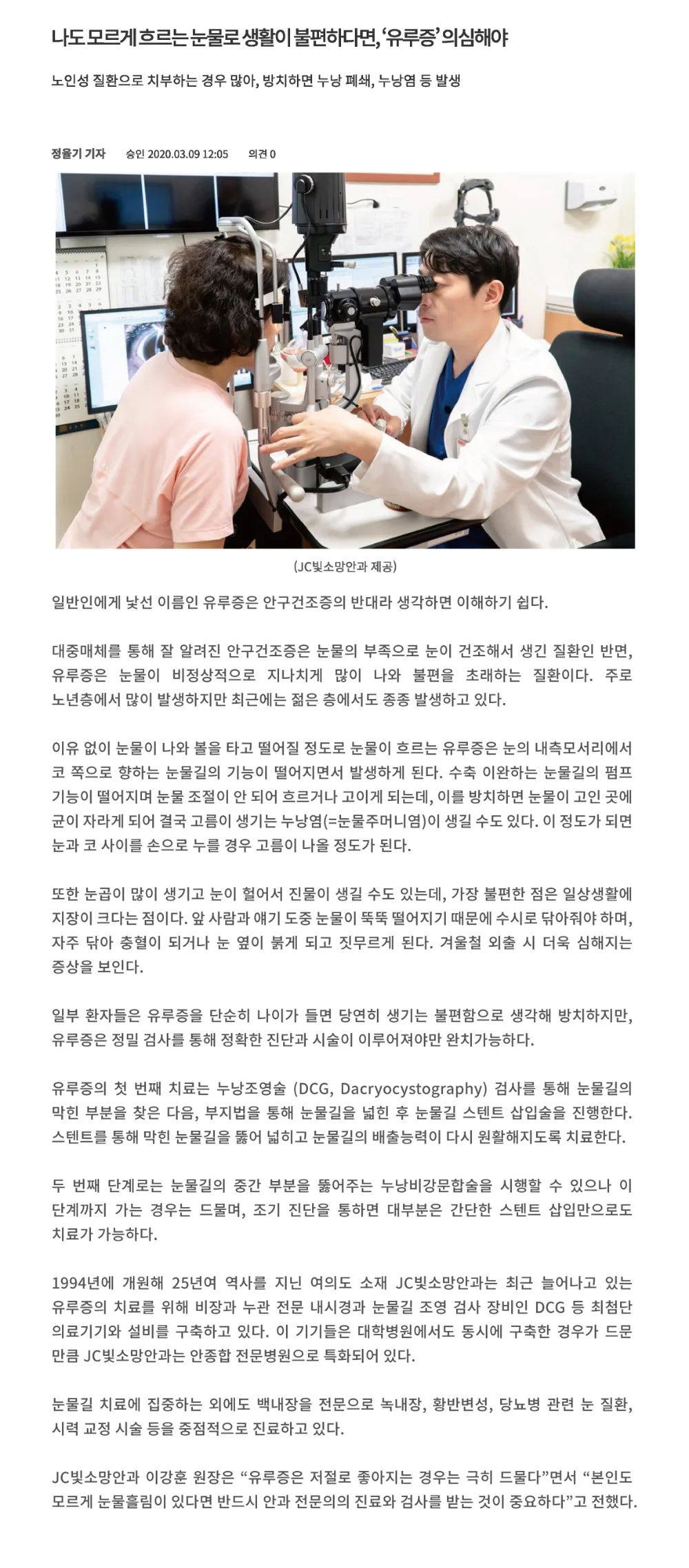
Photo courtesy of JC Bitsomang Eye Clinic.
Epiphora may be an unfamiliar term to the general public, but it can be understood simply as the opposite of dry eye syndrome.
Dry eye syndrome, which is widely recognized through the media, occurs when insufficient tear production causes the eyes to become dry. Epiphora, by contrast, is a condition in which an abnormal excess of tears causes discomfort. Although it is more common among older adults, it has recently been occurring with increasing frequency in younger people as well.
Epiphora, in which tears flow without an apparent reason and may even run down the cheeks, develops when the tear drainage system extending from the inner corner of the eye toward the nose does not function properly.
When the lacrimal pump mechanism, which moves tears through repeated contraction and relaxation, becomes impaired, tears may overflow or collect within the drainage system. If left untreated, bacteria may grow in the stagnant tears and cause dacryocystitis, an infection of the lacrimal sac. In advanced cases, pressing the area between the eye and the nose may cause pus to be discharged.
Epiphora may also cause excessive eye discharge, soreness around the eyes and oozing skin irritation. Its greatest impact, however, is the disruption it causes to daily life.
Tears may continuously drip while a person is speaking with others, requiring frequent wiping. Repeated wiping can lead to eye redness and irritation or raw skin around the eyes. Symptoms often become more severe when going outdoors during the winter.
Some patients dismiss epiphora as a natural inconvenience of aging and leave it untreated. However, a thorough examination, an accurate diagnosis and appropriate treatment are necessary for effective and definitive management.
The first treatment option for epiphora involves performing dacryocystography, or DCG, to identify the location of the obstruction. The tear drainage passage is then widened through probing and dilation, followed by the insertion of a lacrimal stent.
The stent opens and widens the blocked tear duct, helping restore normal tear drainage.
As a second-stage treatment, dacryocystorhinostomy, or DCR, may be performed to create a new drainage pathway between the lacrimal sac and the nasal cavity. However, relatively few patients progress to the point of requiring this procedure.
With early diagnosis, most patients can be treated with a comparatively simple lacrimal stent insertion procedure.
JC Bitsomang Eye Clinic, located in Yeouido, opened in 1994 and has a history spanning approximately 25 years. To treat the growing number of patients with epiphora, the clinic has established advanced medical equipment and facilities, including specialized nasal and lacrimal endoscopes and DCG equipment for imaging the tear drainage system.
According to the article, it is uncommon even for university hospitals to have all of this equipment available together, supporting the clinic’s specialization as a comprehensive ophthalmic medical institution.
In addition to its focus on lacrimal drainage disorders, the clinic specializes in cataract care and provides treatment for glaucoma, macular degeneration, diabetes-related eye diseases and vision correction procedures.
Dr. Lee Kang-hoon of JC Bitsomang Eye Clinic said, “Epiphora very rarely improves on its own. Anyone experiencing unexplained or involuntary tearing should consult an ophthalmologist and undergo a proper examination.”


