



View Original Article ▶ https://www.mk.co.kr/news/society/5470783
[Doctor] A “Gift of Light”: The Medical Community’s Kim Jang-hoon on Overseas Medical Service — “I Gain More Than I Give”… Dr. Gyung Bai Choi, Chief Director of JC Bitsomang Eye Clinic and Renowned Specialist in Presbyopia Treatment
Published: March 7, 2013, 16:12:44 | Last Updated: March 26, 2013, 14:35:26
“During my first volunteer trip to Cambodia, I met a girl of about 14 who had been struck in the eye by a stone she had been playing with and was gradually losing her vision. Cataracts, which usually develop with aging, had occurred as a result of trauma in her case. I can still vividly remember the joyful faces of her family after the surgery was completed.”
An overseas volunteer trip he happened to take in his early forties completely changed the life of one ophthalmologist. Convinced that “this is what I am meant to do,” he has spent the past 13 years boarding planes more than ten times a year, carrying as much as 400 kilograms of surgical equipment.
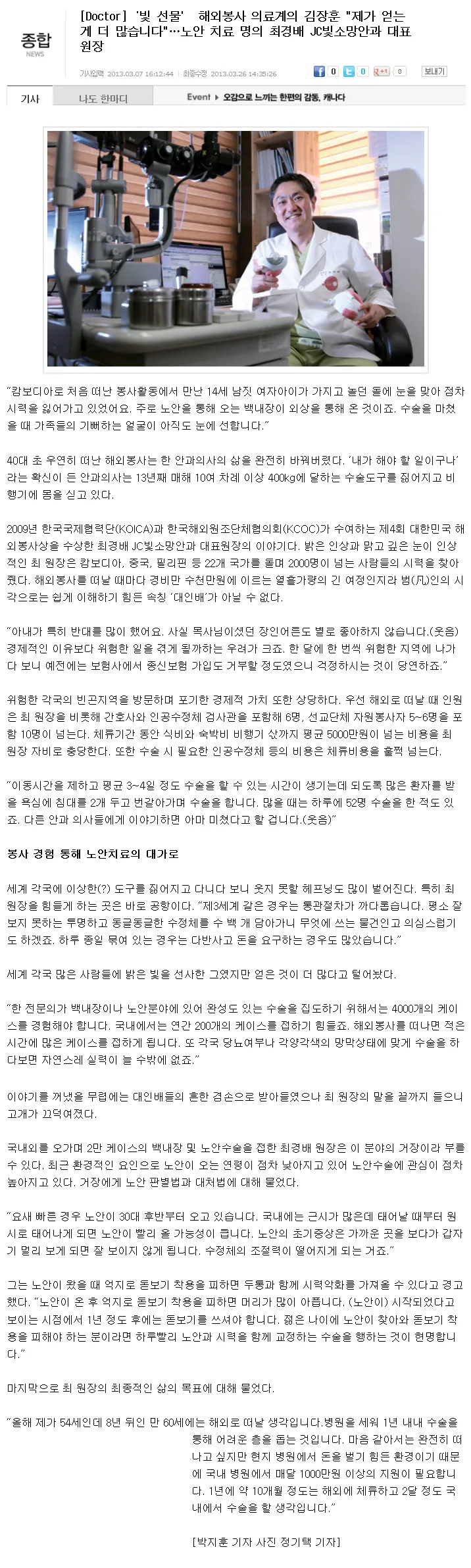
This is the story of Dr. Gyung Bai Choi, Chief Director of JC Bitsomang Eye Clinic, who received the 4th Korea Overseas Volunteer Award in 2009, presented by the Korea International Cooperation Agency (KOICA) and the Korea NGO Council for Overseas Development Cooperation (KCOC). Known for his warm expression and clear, thoughtful eyes, Dr. Choi has traveled to 22 countries, including Cambodia, China, and the Philippines, helping restore the sight of more than 2,000 people. Each overseas medical mission lasts around ten days and costs tens of millions of won, making his level of dedication difficult for most people to imagine.
“My wife was especially opposed to it. In fact, even my father-in-law, who was a pastor, was not very fond of the idea. (Laughs) Their concern was not so much about the financial cost, but about the possibility that I might encounter danger. Since I was traveling to hazardous areas about once a month, there was even a time when an insurance company refused to issue me a whole-life insurance policy. So it was only natural for my family to worry.”
The financial sacrifices involved in visiting impoverished and dangerous regions around the world are also considerable. A typical overseas team consists of more than ten people, including Dr. Choi, nurses and intraocular-lens personnel, as well as five or six volunteers from missionary organizations. Dr. Choi personally covers expenses exceeding an average of KRW 50 million for food, accommodation and airfare during each trip. The cost of intraocular lenses and other surgical supplies required for the procedures can far exceed the travel expenses themselves.
“After excluding travel time, we usually have only three or four days in which we can perform surgery. Because I want to treat as many patients as possible, we set up two beds and alternate between them during surgery. At our busiest, I have operated on as many as 52 patients in a single day. Other ophthalmologists would probably think I was crazy if I told them. (Laughs)”
Volunteer Experience Helped Him Become a Leading Expert in Presbyopia Treatment
Carrying unusual-looking equipment around the world has also led to many difficult and sometimes absurd situations. Airports, in particular, have been a challenge for Dr. Choi.
“Customs procedures can be very complicated in developing countries. When you arrive carrying hundreds of transparent, round intraocular lenses that customs officers rarely see, it is understandable that they may wonder what they are for. Being detained for an entire day was fairly common, and there were also many occasions when people demanded money from us.”
Although he has brought the gift of clearer vision to people around the world, Dr. Choi says that he has gained even more from the experience.
“For a specialist to perform cataract or presbyopia surgery at a truly accomplished level, I believe the doctor needs experience with about 4,000 cases. In Korea, it is difficult to encounter even 200 cases a year. On overseas medical missions, however, you can experience many different cases in a short period of time. You also learn to operate according to each patient’s condition, including whether they have diabetes and the many different states of the retina. Naturally, your surgical skills continue to improve.”
At first, his comment that he had gained more than he had given sounded like the usual humility of an exceptionally generous person. But after listening to Dr. Choi’s full explanation, it was easy to understand what he meant.
Having performed approximately 20,000 cataract and presbyopia surgery cases in Korea and abroad, Dr. Choi can be regarded as a leading figure in the field. Recently, interest in presbyopia surgery has been increasing as environmental factors appear to be contributing to the condition developing at younger ages. We asked him how to recognize presbyopia and how to respond to it.
“These days, in some cases presbyopia begins as early as the late thirties. Myopia is common in Korea, but people who are hyperopic from birth have a greater likelihood of developing presbyopia earlier. One early symptom is difficulty seeing clearly when suddenly shifting your focus from something nearby to something farther away. This happens because the eye’s crystalline lens loses some of its ability to accommodate.”
He warned that deliberately avoiding reading glasses after presbyopia develops could lead to headaches and worsening visual discomfort.
“If you force yourself not to wear reading glasses after presbyopia develops, you can experience severe headaches. About a year after you begin to notice the onset of presbyopia, you may need to start using reading glasses. For younger people who develop presbyopia and wish to avoid reading glasses, surgery that addresses both presbyopia and refractive vision may be an option to consider.”
Finally, Dr. Choi was asked about his ultimate goal in life.
“I am 54 this year, and in eight years, when I reach 60, I plan to move overseas. I want to establish a hospital and spend the entire year helping people in need through surgery. Ideally, I would like to devote myself to it completely, but because it is difficult for a hospital there to generate sufficient income, I would need more than KRW 10 million in support each month from my hospital in Korea. I plan to spend about ten months of each year overseas and return to Korea for roughly two months to perform surgery.”
[Reporter Park Ji-hoon | Photo: Reporter Jeong Gi-taek]


