



View Original Article ▶ https://www.mk.co.kr/news/culture/5509716
[Health] Presbyopia Correction: Anti-Aging for the Eyes
Published: April 8, 2013, 15:03:25 | Last Updated: April 26, 2013, 09:22:50
There are many sayings that emphasize the importance of vision, such as “The eyes are the window to the soul,” “If the body is worth 100, the eyes are worth 99,” and “Seeing once is better than hearing a hundred times.”
These expressions illustrate just how important our eyes are among all parts of the body. They also suggest that what we see can influence our choices and even change the course of our lives.
The eyes are among the organs that show signs of aging relatively early, and presbyopia generally begins to progress gradually after the age of 50. However, in recent years, the age at which people begin experiencing presbyopia has been getting younger, partly due to lifestyle habits that place strain on the eyes, including frequent smartphone use.
Ironically, while advances in living standards and medicine have increased average life expectancy, the age at which presbyopia begins appears to be decreasing.
Recently, an increasing number of middle-aged people in their 40s and 50s, who remain highly active professionally and socially, have been seeking presbyopia correction because of the earlier onset of symptoms.
Presbyopia correction can reduce dependence on reading glasses when reading newspapers and may also reduce the need for corrective glasses, making presbyopia-correction surgery an option for people who lead active social and professional lives.
So why does presbyopia occur?
The human eye contains a crystalline lens that automatically adjusts focus, much like the autofocus function of a camera. When looking at distant objects, the lens becomes thinner, while it becomes thicker when focusing on nearby objects. As we age, the crystalline lens gradually loses flexibility and the muscles involved in accommodation become less effective. As a result, the eye's ability to focus gradually decreases. Presbyopia is an age-related change that virtually everyone experiences.
Common symptoms of presbyopia include slower adjustment when shifting focus between distant and nearby objects and blurred or hazy vision. These symptoms can cause inconvenience during everyday activities such as reading, checking text messages on a mobile phone, applying makeup, and working on a computer.
Because symptoms of presbyopia and hyperopia can appear similar, some people may receive inappropriate correction, which may negatively affect visual comfort.
Hyperopia occurs when the eyeball is relatively short, causing light from nearby objects to focus behind the retina rather than directly on it. This is fundamentally different from presbyopia, which results from reduced accommodative ability of the crystalline lens. People with hyperopia require additional accommodation when viewing nearby objects and may therefore notice presbyopic symptoms earlier.
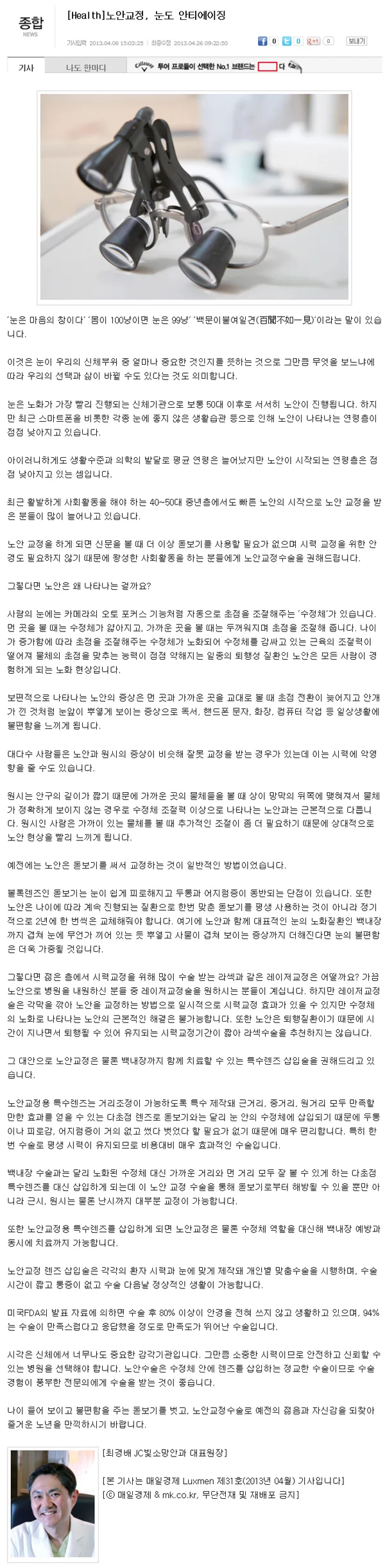
In the past, the most common method of correcting presbyopia was the use of reading glasses.
Reading glasses use convex lenses, and the article notes that they may be associated with eye fatigue, headaches, or dizziness in some users. Because presbyopia continues to progress with age, the same pair of reading glasses cannot necessarily be used indefinitely and may need to be replaced periodically. If cataracts, another common age-related eye condition, develop alongside presbyopia and cause hazy or overlapping vision, visual discomfort may become even greater.
What about laser vision-correction procedures such as LASEK, which are commonly performed in younger people? Some patients who visit the clinic for presbyopia ask about laser vision correction. However, laser procedures reshape the cornea and may provide refractive correction, but they do not fundamentally reverse presbyopia caused by age-related changes in the crystalline lens. Because presbyopia continues to progress over time, the article does not recommend LASEK as a primary solution for presbyopia.
As an alternative, lens implantation surgery designed to correct presbyopia and address cataracts is introduced.
Special lenses for presbyopia correction are multifocal lenses designed to provide vision at near, intermediate, and far distances. Because they are implanted inside the eye rather than worn externally like reading glasses, they eliminate the need to repeatedly put glasses on and take them off.
In this procedure, the aging crystalline lens is replaced with a special multifocal lens designed to provide useful vision at both near and far distances. The article explains that this type of presbyopia-correction surgery can reduce dependence on reading glasses and may also correct refractive errors such as myopia, hyperopia, and astigmatism.
It also states that replacing the natural lens with a presbyopia-correcting intraocular lens can address presbyopia while simultaneously treating lens-related cataract problems.
Presbyopia-correcting lens implantation is planned according to each patient's visual condition and ocular characteristics. The article describes it as a customized procedure with a relatively short surgical time and rapid return to normal daily activities.
According to U.S. FDA data cited in the article, more than 80% of patients reportedly lived without regularly using glasses following surgery, while 94% responded that they were satisfied with their procedure.
Vision is one of the body's most important senses. Because eyesight is so valuable, it is important to choose a safe and trustworthy medical institution. Presbyopia surgery is a delicate procedure involving implantation of an intraocular lens, so the article recommends receiving treatment from an experienced ophthalmic specialist.
By reducing dependence on reading glasses and undergoing appropriate presbyopia correction, patients may be able to regain greater convenience and confidence in their later years.
[Dr. Gyung Bai Choi, Chief Director of JC Bitsomang Eye Clinic]
[This article was originally published in Maeil Business Newspaper’s Luxmen, Issue No. 31, April 2013.]
[(C) Maeil Business Newspaper & mk.co.kr. Unauthorized reproduction and redistribution prohibited.]


