



Concurrent Presbyopia and Cataracts Require Attention; Early Diagnosis and Personalized Treatment Are Essential
By Kim Dong-yeol
Published: February 27, 2026, at 3:01 p.m.
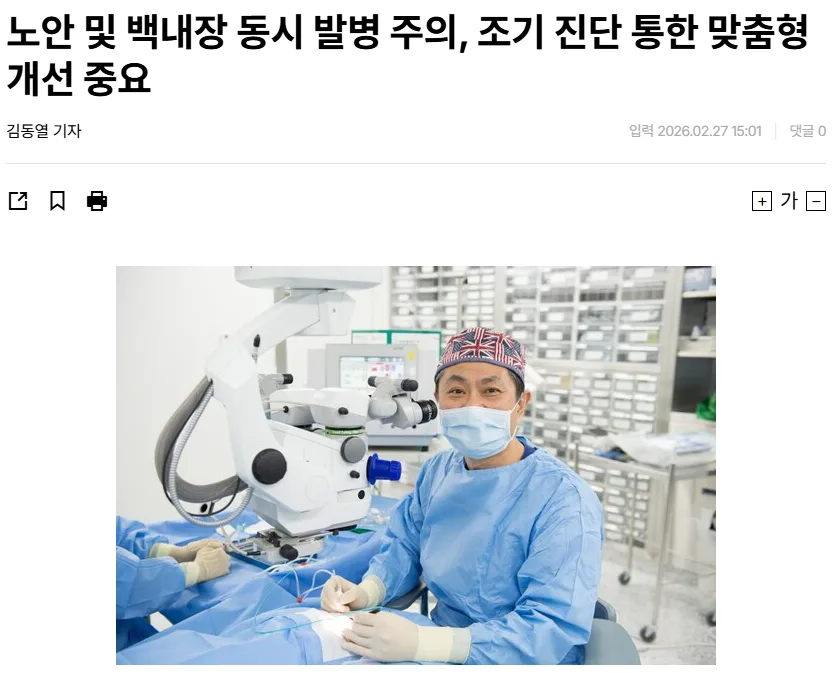
As temperatures rise and people begin spending more time outdoors, age-related physical changes may become more noticeable among middle-aged and older adults. Declining vision, in particular, can have a direct impact on quality of life.
Although blurred vision is often dismissed as a natural consequence of aging, visual problems during this stage of life may involve more than presbyopia alone. Cataracts and other eye conditions may also be present, making careful evaluation important.
The resulting difficulties in everyday life can be more specific than many people realize. Common examples include having to hold a smartphone farther away to bring small text into focus or experiencing eye fatigue when reading stock listings in a newspaper or fine print in a magazine.
Some people also report anxiety when driving at night because streetlights appear blurred or spread out and the outlines of objects become less distinct. These symptoms can affect more than visual clarity, potentially leading to reduced confidence and a narrower range of daily activities.
Presbyopia and cataracts are often confused because both can cause blurred or hazy vision. Presbyopia occurs when the natural lens loses elasticity, reducing the eye’s ability to focus on nearby objects. A cataract, by contrast, develops when the normally clear natural lens becomes cloudy, making the overall field of vision appear as though it is covered by fog.
If an advanced cataract is left untreated, it may cause more than visual discomfort and, in some cases, can contribute to complications such as secondary glaucoma. A comprehensive eye examination should therefore come first.
Appropriate treatment begins with a comprehensive assessment of the patient’s ocular condition and daily visual needs. One widely used approach involves removing the clouded natural lens and replacing it with a multifocal intraocular lens.
This procedure may help improve vision at near, intermediate and far distances and reduce dependence on reading glasses. Most importantly, the intraocular lens should be selected and positioned precisely after considering individual factors such as corneal curvature, axial length and retinal condition.
Dr. Gyung Bai Choi, Chief Director of JC Bitsomang Eye Clinic, emphasized that it can be risky to dismiss declining vision as an unavoidable part of aging and leave it unexamined.
He added that the early symptoms of cataracts can resemble those of presbyopia, which may delay diagnosis. Regular eye examinations and timely intervention are therefore essential for protecting long-term eye health.


