



“Providing Light and Hope Through Eye Care Is My Lifelong Calling”
Published: May 29, 2019, at 12:06 a.m.
Dr. Gyung Bai Choi of JC Bitsomang Eye Clinic Has Carried Out Medical Missions in 19 Countries Over 20 Years
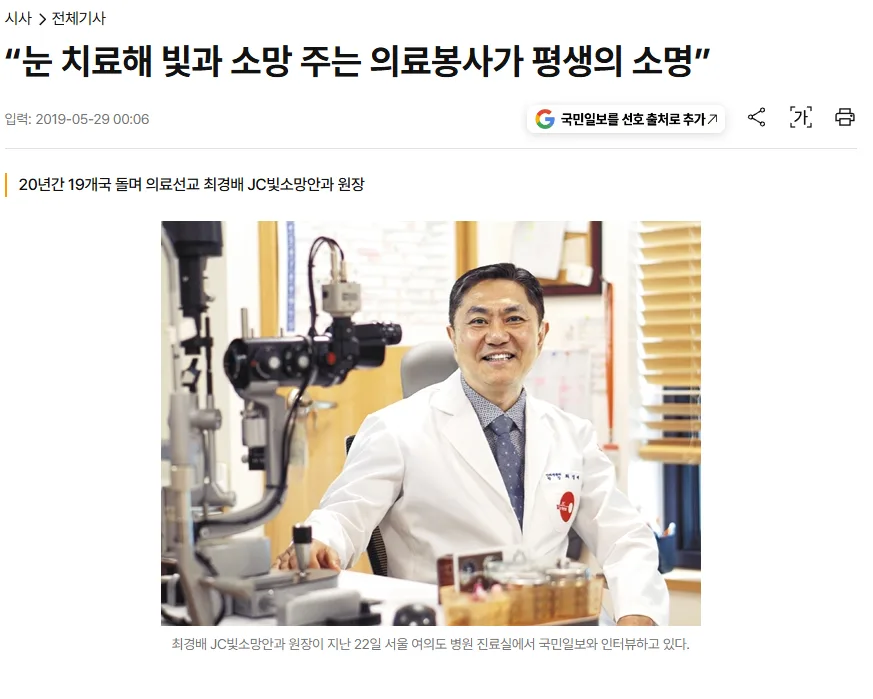
Dr. Gyung Bai Choi of JC Bitsomang Eye Clinic speaks with Kukmin Ilbo during an interview in his consultation room in Yeouido, Seoul, on May 22.
JC Bitsomang Eye Clinic, led by Dr. Gyung Bai Choi,
is well known for its expertise in presbyopia and cataract surgery. Within the Christian community, however, it is even better known as a clinic devoted to medical missions.
The clinic conducts at least three medical outreach programs each year and, in some years, more than ten. It works in partnership with Good People, an international relief and development NGO, and recently visited Shinan County in South Jeolla Province with the E-Land Foundation.
Its teams also travel overseas frequently. Since 1999, the clinic has carried out medical missions in 19 countries and regions, including Yanbian in China, the Philippines, Vietnam, Sri Lanka, Timor-Leste and Fiji in the South Pacific. In Yanbian alone, it worked with Seogu Hospital, affiliated with Yanbian University, to conduct 60 medical missions over a ten-year period.
During an interview at JC Bitsomang Eye Clinic in Yeouido on May 22, Dr. Choi, then 58, said,
“In two years, when I turn 60, I plan to be formally commissioned to an overseas mission field and serve as a medical missionary for ten years.”
He added, “I want to dedicate an entire chapter of my life to God.”
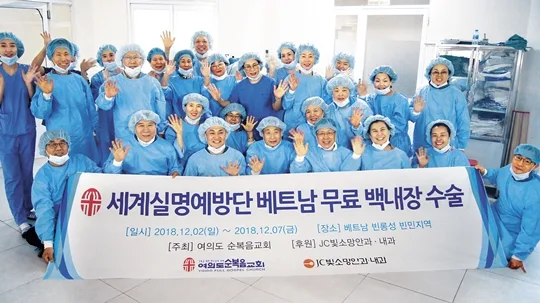
Dr. Gyung Bai Choi, third from left in the front row, poses with the medical mission team after completing a free cataract surgery program organized by the World Blindness Prevention Team in an underserved community in Vinh Long Province, Vietnam, from December 2 to 7 of the previous year. Photo courtesy of JC Bitsomang Eye Clinic.
Dr. Choi became fully committed to medical missions after meeting a young girl in Cambodia. The girl, approximately 14 years old, was gradually losing her sight after being struck in the eye by a stone.
“I can never forget the expression on her parents’ faces when I came out after completing the surgery,” he recalled. “That was when I became certain that this was the work I was meant to do.”
From that point forward, Dr. Choi devoted even more of his time and financial resources to medical missions. To provide a wider range of treatment, he and his team often transported substantial amounts of medical equipment themselves, as many of the communities they visited had no proper surgical facilities.
Together with the clinic’s medical staff, he carried approximately 600 kilograms of equipment, including surgical microscopes and sterilizers. The team also brought laser-based medical equipment used in cataract surgery.
Vitreoretinal surgery was also required in the medical mission field because many patients had advanced cataracts that had remained untreated for long periods. Such cases were more likely to involve surgical complications, including posterior capsule rupture, lens dislocation and vitreous prolapse. When these complications occurred, additional vitreoretinal surgery could be necessary.
To prepare for such cases, Dr. Choi received specialized training in retinal surgery and had been performing these procedures for ten years.
Dr. Choi is a devout Christian and serves as an elder at Yoido Full Gospel Church in Seoul. He began attending church with his mother when he was in the fifth grade. He said that his decision to specialize in ophthalmology was also an act of obedience to God.
“While I was serving as a public health physician, I kept thinking about ophthalmology whenever I prayed,” he said. “It was a specialty I had never previously considered. There were only a limited number of residency positions, so the competition was intense. But I became increasingly convinced that this was what God wanted me to pursue, and that gave me the courage to take on the challenge.”
In 1994, Dr. Choi opened Choi Eye Clinic, which focused on the treatment of eye diseases. Within ten years, the clinic had performed 10,000 cataract surgeries, after which he changed its name to JC—Jesus Christ—Bitsomang Eye Clinic.
He sought to bring “light and hope” to people who were unable to receive ophthalmic surgery for financial, geographic or other reasons. He was particularly committed to restoring sight among ethnic Koreans living in China.
He also received training in corneal transplantation from a leading specialist at Apollo Hospitals in India, described in the article as one of the world’s top hospitals. In 2016, the clinic established an eye bank and opened a corneal transplantation center.
The clinic had performed approximately 63,000 presbyopia and cataract procedures in Korea and overseas.
“Many people do not take presbyopia seriously,” Dr. Choi said. “However, the earlier it is properly evaluated and addressed, the better the potential outcome.”
Presbyopia commonly causes blurred near vision. Because the symptoms progress gradually, they are sometimes mistaken for ordinary eye fatigue. In the past, patients were often advised to use reading glasses or undergo presbyopia-correcting LASIK.
Presbyopia LASIK frequently uses a monovision approach, correcting one eye primarily for distance vision and the other for near vision. Because the two eyes are given different focal targets, some patients may require considerable time to adapt and may eventually need reading glasses again.
Dr. Choi said that lens replacement surgery, in which the natural lens is removed and replaced with a multifocal intraocular lens, had increasingly become an option. According to the article, this procedure offers a relatively rapid recovery and may address presbyopia, myopia, astigmatism and cataracts.
He also advised that cataracts can easily be confused with presbyopia because the symptoms may appear similar. As a result, some patients may delay necessary cataract treatment or miss an appropriate time for surgery.
When asked how people could protect their eyes from presbyopia and cataracts, Dr. Choi advised limiting prolonged exposure to smartphones, computer monitors and other sources of eye strain. He also recommended regular eye exercises and routine ophthalmic examinations.
JC Bitsomang Eye Clinic also operates an internal medicine department and manages potential complications through a coordinated multidisciplinary care system. It is equipped with a sterile operating room suitable for procedures including corneal transplantation.
“Treating people’s eyes and giving them light and hope is the calling God has given me,” Dr. Choi said. “In the future, I hope to treat not only eye diseases but a broader range of conditions so that I can bring hope to even more people.”
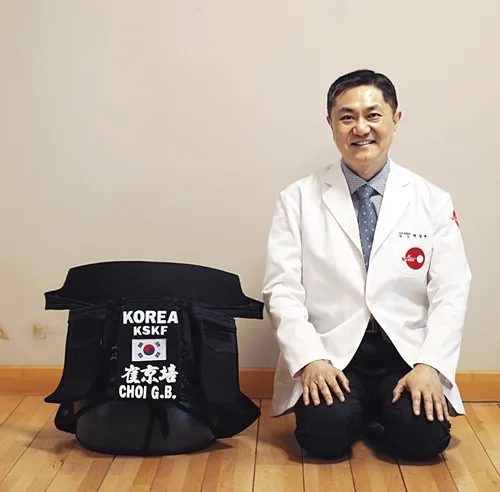
Dr. Gyung Bai Choi poses beside a set of kendo armor in the private training room he built next to his consultation room.
Dr. Choi holds a fifth-degree black belt officially recognized by the Korea Kumdo Association. After the interview, he showed the reporter a private room connected to the back of his consultation area.
The approximately 33-square-meter training room had a raised ceiling to provide enough space for swinging a bamboo sword and a wooden floor suitable for practice. Two sets of protective kendo armor faced each other inside the room.
Because his demanding clinical schedule often prevented him from visiting a regular training center, Dr. Choi received private instruction there. A cross hanging on the wall suggested that the room was used not only for physical training but also for prayer.
Text and Photographs by Jeon Byeong-seon
Kukmin Ilbo


