



By Kim Ji-hoon
Published: May 24, 2018, at 10:37 a.m.
With the widespread adoption and increased use of digital devices, the number of relatively young patients in their 40s and 50s experiencing presbyopia and cataracts has risen sharply.
According to the Health Insurance Review and Assessment Service, presbyopia and cataracts remain most prevalent among people in their 60s and 70s. However, recent age-specific trends show a significant increase in the number of patients in their 40s and 50s.
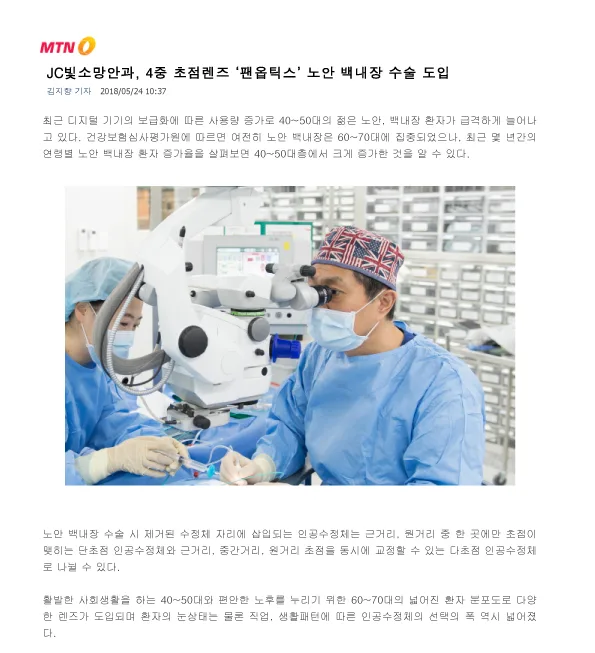
During cataract surgery with presbyopia correction, the clouded natural lens is removed and replaced with an intraocular lens.
Intraocular lenses can generally be divided into monofocal lenses, which provide a single focal point for either near or distance vision, and multifocal lenses, which are designed to provide vision at near, intermediate and far distances.
As the patient population has expanded to include socially active people in their 40s and 50s, as well as those in their 60s and 70s seeking greater visual convenience in later life, a wider variety of intraocular lenses has become available.
This has broadened the range of lens options that can be selected according to each patient’s eye condition, occupation and lifestyle.
http://news.mtn.co.kr/newscenter/news_viewer.mtn?gidx=2018052410212730043


